© 2026 Rentokil Initial plc © JP Pest Services. All Rights Reserved.
The common eastern carpenter bee, Xylocopa virginica, often attacks unpainted (unstained or treated) softwoods used for windowsills, trim boards, eaves, rafters, fascia-boards, siding, (wood) roof shakes, decks, and unpainted furniture. It is a large bee ¾ to 1 inch in length, like a large bumble bee with a smooth shiny black abdomen (bumble bees are completely covered in hairs). Carpenter bees prefer weathered wood, but do not eat wood, just mine it out to create galleries in which to rear their young. They cannot attack wood inside homes unless windows and doors lack screens.
What’s the concern?
Carpenter bees must be provoked or handled very roughly in bare hands or stepped on with a bare foot to sting. Only female carpenter bees have stingers; males may act aggressively but cannot sting. Females mine nest galleries and provision them with food (pollen and nectar) for their offspring without any help. They are solitary bees and have no queen or nest to defend, and therefore, are not aggressive.
Carpenter bee females create large galleries in wood, roughly 6 to 12 inches in length and ½ inches in diameter. These galleries are used to rear their young. Therefore, if many bees are utilizing the same wood member, structural failure is possible. However, this is usually not the case because of the type of wood attacked and its use. The damage is usually more cosmetic than structural. However, woodpeckers may greatly enlarge these holes in their pursuit of overwintering bees.
What can be done? How can carpenter bees controlled?
Controlling carpenter bees is best left to a professional because we have specialized treatment equipment that can reach great heights, whereby the homeowner may need to use a ladder to reach the nests. Dealing with stinging insects while balancing on a ladder is very dangerous work and can lead to serious injuries. Timing applications to bee activity periods and ensuring bees contact these materials is essential for control. Carpenter bees are very loyal to their native homes. So, if bees and their offspring are not killed, the next generation will return to attack the same pieces of wood the following year. Replacing softwood boards with hardwood or plastic wood is reported to thwart their burrowing activities. Similarly, finishing wood by painting, staining, varnishing, etc. will also help because carpenter bees prefer bare, weathered wood. Softwoods preferred are redwood, cedar, cypress, and pine.
Carpenter bee traps are also available online and from garden supply stores. These may help reduce the amount of new activity (new gallery formation). However, if nothing is done to protect or replace the attacked wood, traps alone will not be able to halt an infestation. Also, wood that has been attacked by woodpeckers should be replaced to restore structural integrity and keep out weather (rain, wind, etc.).
Carpenter Bees or Bumble Bees – Which do I have?
.2023-10-31-13-54-50.webp)
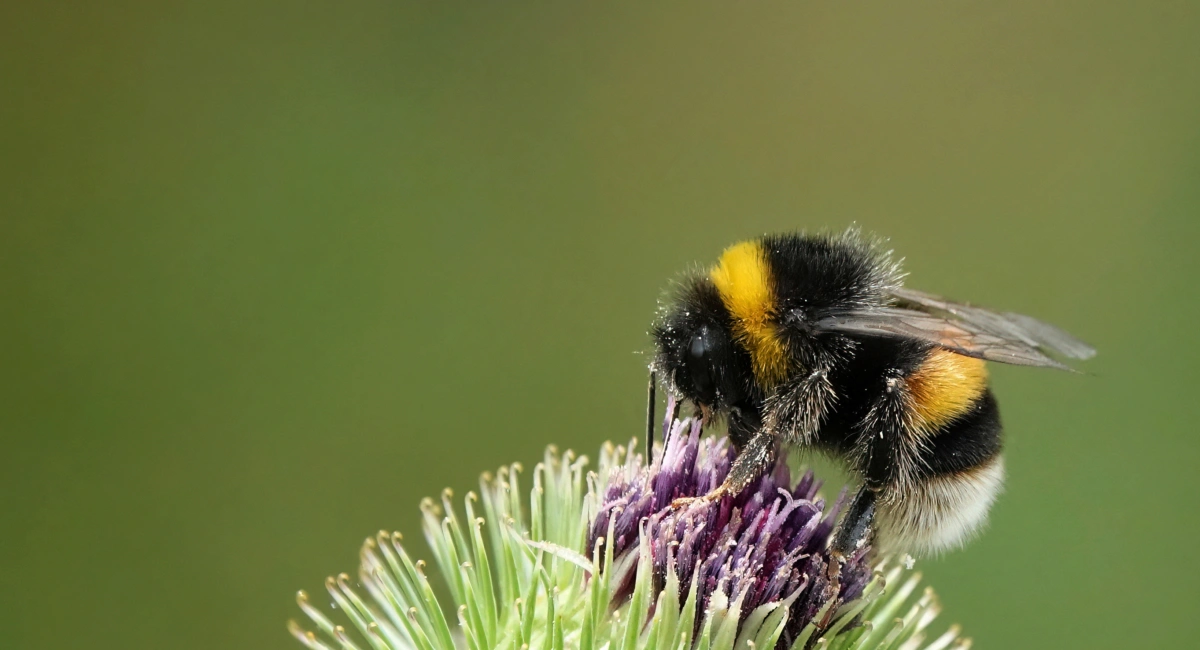
If you are uncertain of the type of bees you have and cannot get close enough to take a picture, here are a few tips:
- Carpenter bees usually nest above head height by drilling (boring) galleries in wood. While creating their nests, wood chips (shavings) and loud buzzing noises are evident along with staining of surfaces directly under their entrance holes. Bumble bees usually nest in the ground or brush piles and often utilize old rodent burrows. They rarely nest above waist height.
- Has anyone been stung? Again, it is highly unlikely that carpenter bees would sting. Bumble bees, however, are social insects meaning that their workers will defend their nest and queen until their very last buzz. When nests are disturbed, people and pets will be stung. If bumble bees utilize wood or structural materials to nest, there will be no perfectly cut circular nest entrance holes in wood that bees can be seen going in and out of.
- Carpenter bees are all about the same size; bumble bee workers, especially the first brood of spring, may be much smaller, about half the size, than carpenter bees.
- Carpenter bee nests are more commonly found inside structures and wood boards than are bumble bees. Follow the yellowish stain lines to locate carpenter bee nests. Bumble bee nests are often more difficult to discover and observe.
Bottom Line:
Pests are those organisms that harm us or our possessions in some way. Most of those we encounter are harmless. However, a few minutes of your time spent carefully observing your home or business can make a world of difference in late spring and throughout summer. When control is necessary, JP Pest Services employs IPM (Integrated Pest Management). Like all pest management issues, IPM requires expertise, experience, and attention to detail.
There is no silver bullet or magic pill, even highly effective products must be used judiciously when and where needed and in conjunction with other non-pesticidal techniques. JP Pest Services’ highly trained Service Professionals have the skill and training to help you understand and deal with any situation. JP Pest Services is ready to solve the toughest pest problems, and thereby, make life better and more enjoyable for our valued customers!
Book Your Free Pest Inspection Today
Our local technicians will assess your property and recommend tailored solutions. Fast, friendly, and completely obligation-free.
- Safe, targeted treatments
- Local experts, fast response
- Trusted, trained technicians