© 2026 Rentokil Initial plc © JP Pest Services. All Rights Reserved.
Ask most New England homeowners when they see the most ants, and they'll say "summer." What they may not realize is that increased activity almost always correlates with heavy, driving rain.
Late-summer thunderstorms cause rapid drops in barometric (atmospheric) pressure and saturate the ground, forcing shallow-nesting ant colonies to abandon flooded soil and seek the dry shelter of nearby foundation walls and wall voids.
In New England, August is the peak season for these sudden convective storms—severe thunderstorms driven by the rapid upward movement of warm, moist air. For homeowners, understanding this biological response means you can finally stop viewing post-storm ant invasions as random bad luck and start treating them as predictable events that can be managed and prevented.
The Barometric Warning and the Flood
Ants are incredibly attuned to changes in the atmosphere. Hours before a storm actually hits, a drop in air pressure signals a change in the weather. This pressure drop acts as an alarm bell for ant colonies, instinctively triggering worker ants to increase their foraging activity and prepare to relocate.
Once the rain begins, the physical threat takes over. Many common ants build their nests just inches below the soil surface, beneath driveways, patio pavers, or garden mulch. A heavy August downpour fundamentally destroys these shallow habitats. Facing a waterlogged nest, the colony immediately migrates to higher, drier ground. More often than not, the closest dry harbor is the interior of your home.
The 24 to 48-Hour Warning Window
You rarely see ants when it's raining. Instead, a summer ant infestation in Maine, Rhode Island, Vermont, and throughout New England typically manifests within a specific timeframe: 24 to 48 hours after the skies clear and the sun returns.
Why the delay? It takes time for a displaced colony to get organized. During this time, displaced ants establish temporary trails to scout for food and moisture inside the house. You’ll see them edging along foundation-level baseboards, trailing near exterior doorways, or investigating moisture-rich rooms like kitchens, bathrooms, and laundry spaces.
If this activity coincides with recent local weather patterns, you are likely dealing with colony movement triggered by a storm rather than an established indoor nest.

Know Your Local Suspects
Not all ants react to rain in the same way, and the response depends on the specific species. Across the northeast, three distinct species drive the vast majority of storm-related activity.
Pavement Ants
These are the most common post-storm invaders we see. Just like their name suggests, pavement ants nest tightly against concrete foundations, under brick walkways, and beneath driveways. When minor pooling water builds up against your foundation during a storm, it flushes these ants out of their dirt mounds, which is when they slip inside through expansion joints, microscopic cracks in the concrete, or under the weatherstripping.
Odorous House Ants
Often called 'sugar ants'—and known for the distinct, rotting coconut smell they release when crushed—odorous house ants are highly mobile and incredibly adaptable. When their shallow-yard nests flood, they don't just send in a few scouts; they are notorious for moving their entire colony into your wall voids or beneath the floorboards, camping out comfortably until the outdoor soil dries.
Carpenter Ants
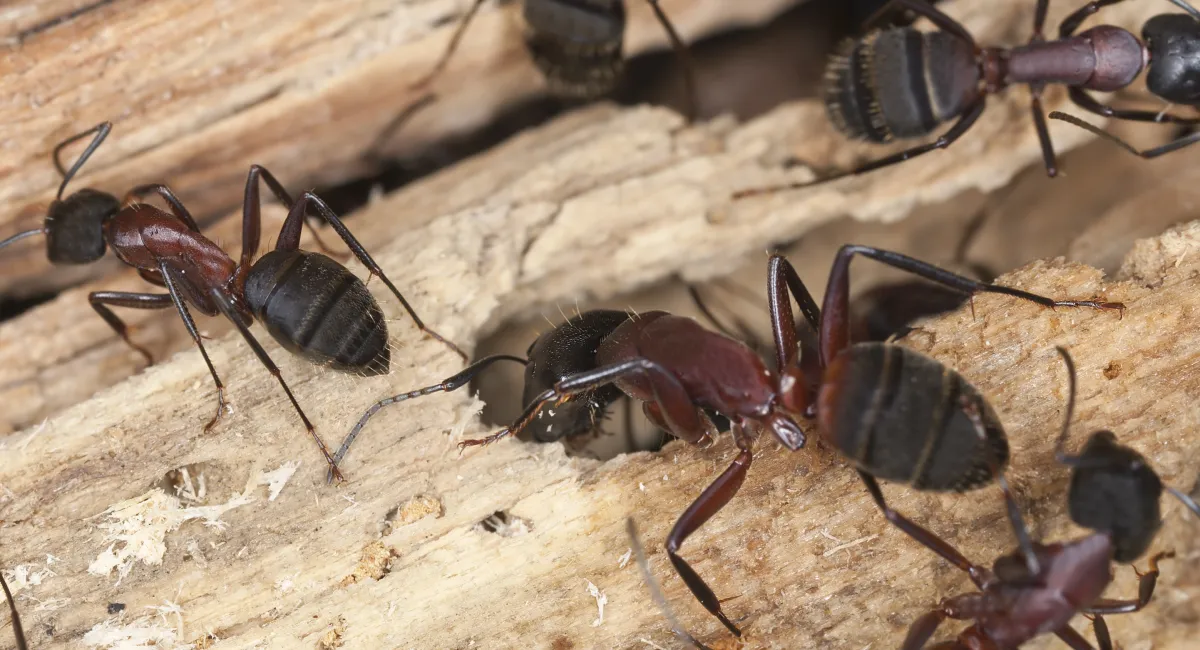
The stakes are higher with carpenter ants as they present a major structural risk. While a pavement ant is merely treating your kitchen as a temporary rain shelter, carpenter ants make a beeline for damp, water-damaged wood to carve out their galleries, which can undermine the integrity of your building.
If you experience a sudden wave of large, black carpenter ants inside after a storm, it could indicate pre-existing moisture issues or a rotting wood problem. When driving rain saturates a leaky window frame, compromises the roof fascia, or dampens the sill plate, carpenter ants will move in and take advantage of the wet, easily chewable wood to expand their tunnel network.
Temporary Displacement or Established Colony?
You’ll be pleased to know that weather-driven displacements are temporary. As the outdoor soil dries over, pavement and odorous house ants will naturally migrate back outside to rebuild their nests, and indoor activity will noticeably taper off and eventually disappear.
On the other hand, an established interior colony does not leave when the weather improves. If the trails persist for weeks, or if you consistently see ants emerging from the exact same interior crevice, whether it’s sunny or raining outside, the colony has likely set up a satellite nest inside your walls. At that point, they’re probably here to stay, long-term.
Preparing for the Next Storm
You obviously cannot control the August weather, but you can control how your home copes with it. Preventing post-storm ant activity relies heavily on managing moisture around your property and physically excluding pests before the rain starts.
- Manage perimeter drainage: Take a walk around your house during the next rainstorm. Are your gutters overflowing? Are the downspouts dumping water right against the siding? Ensure gutters are clear and extend downspouts so they push water at least three to four feet away from the foundation. The drier the soil directly touching your home, the less likely nearby nests are to flood and flush pests inside. Also, be mindful of thick mulch beds directly touching your siding, as these act like moisture-retaining sponges that ants love.
- Seal the entryways: Ants don't need an open door; they just need a tiny structural gap to access your building. Take time to caulk foundation cracks, repair compromised or cracked weatherstripping around exterior doors, and seal the gaps where plumbing, electrical, and HVAC lines enter the house.
- Fix interior moisture: Make your home as unappealing to a waterlogged ant as possible. Fix slow plumbing leaks under sinks, ensure your bathroom vent fans are actually pulling humid air outside, and run dehumidifiers in damp basements or crawl spaces. If your home lacks the moisture that odorous house ants and carpenter ants crave, they are far less likely to stick around after the storm passes.
Don't let every thunderstorm trigger an endless cycle of reactive ant spraying. Instead, adopt a proactive stance with our year-round Home Protection Plan, which ensures your home’s perimeter remains secure and monitored. By combining this with targeted residential pest control solutions, we can identify exactly what’s invading your kitchen and seal the entry points, ensuring that when the next New England storm hits, ants stay exactly where they belong: outside in the rain.
You can’t control the August forecast, but you can control how your home handles it. Talk to our New England team about year-round protection that keeps ants outside where they belong.
Book Your Free Pest Inspection Today
Our local technicians will assess your property and recommend tailored solutions. Fast, friendly, and completely obligation-free.
- Safe, targeted treatments
- Local experts, fast response
- Trusted, trained technicians