© 2026 Rentokil Initial plc © JP Pest Services. All Rights Reserved.
Knowing how to identify carpenter ants is crucial if you find ants in your home or business and suspect the problem is more than a minor annoyance. Carpenter ants are often confused with termites, however unlike these pests, they don’t eat wood. Still, their hidden nests can cause serious structural issues if colonies are left to grow. Identifying carpenter ants correctly helps you to recognize the species and understand why they are there, so you can plan next steps to solve the problem.
Carpenter ants can vary in appearance within the same colony, which is why focusing on physical traits, habitat, and activity patterns, and not size alone, is essential for identification. Learning these details can help prevent repeated infestations caused by missed nests or incomplete treatment.
Species: Camponotus SPP.
Season: Spring, Summer, Autumn, Winter
Size: 1/4” – 3 /4”
Region: Throughout the U.S. but more common in the North
About Carpenter Ants
Carpenter ants are named for their ability to excavate wood to build nests. They create complex tunnel systems that allow them to remain hidden while foraging for sweet and protein-rich foods to support growing carpenter ant colonies. They are among the largest ant species found in homes and commercial buildings, with workers ranging in size from ¼ to ¾ inch. Workers within the same colony may vary in size, making this an imprecise marker for accurate identification. However most carpenter ants are black, dark brown or reddish, depending on the region.
A key feature used in carpenter ant identification is the smooth, rounded thorax when viewed from the side. Unlike termites, carpenter ants have bent antennae and a narrow waist. Access to moisture is critical for colony survival, which is why they mainly target wet and decaying wood. Carpenter ants may also build nests in rigid foam insulation or behind fiberglass, where wood isn’t an option.
If you are experienceing a problem with Carpenter ants in your home or business, find out more about our ant control process.
Seeing Ants?
Call now to book your free inspection.
How to Spot Carpenter Ant Damage
The signs can be subtle, but if you know what to look or listen for, you’re more likely to locate problem areas early on and get the help you need to limit further spread:
- Frass and winged ants: Small piles of sawdust-like material (frass) and occasional winged ants indoors may indicate a nearby carpenter ant colony.
- Sounds within structures: Faint rustling or tapping noises inside walls or ceilings, especially at night, can signal carpenter ant activity.
- Moisture-damaged wood: Window frames, door frames, roof eaves, decks, or areas near plumbing leaks are common damage sites.
Carpenter ant damage develops slowly, and ignoring the warning signs allows colonies to expand and establish additional nests in your property.
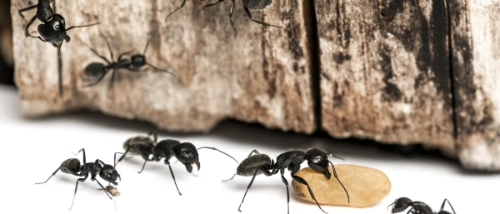
Carpenter Ant Habitat
Knowing where carpenter ants like to live is important for controlling them. Outdoors, they nest in rotting logs, tree stumps, piles of firewood, and other sites large enough to support parent colonies that feed satellite nests closer to, or inside, buildings.
Indoors, the preferred carpenter ant habitat is damp or damaged wood. Wall voids, crawl spaces, attics, and areas near leaking pipes are common spots. Over time, excavation activity can weaken wood, allowing colonies to expand deeper into structures, making them difficult to locate without professional tools and experience.
A single infestation may involve multiple interconnected carpenter ant colonies. This nesting strategy allows them to remain active even if part of the colony is disrupted, making long-term control more challenging.
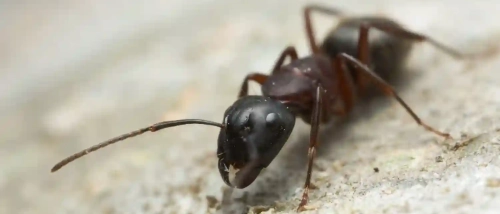
Carpenter Ant Behavior
Understanding carpenter ant behavior explains why infestations often persist after DIY or surface treatments. Carpenter ants are primarily nocturnal, foraging at night for food. As a result, daytime activity may appear minimal even when a large colony is present.
Carpenter ants eat sugars, proteins, and other insects, entering kitchens, restrooms, and living rooms to look for easy meals. Once food sources are established, they form extensive foraging trails that may travel through walls, ceilings, and along foundations.
Rather than relying on a single nest, carpenter ants create satellite nests that perform different functions, such as housing workers or supporting reproduction. This distributed colony structure makes carpenter ants particularly difficult to eliminate unless all nests are identified and treated.
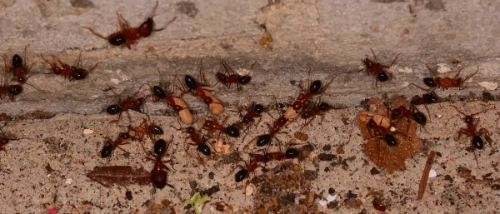
Carpenter Ant Life Cycle
New colonies begin when a fertilized queen establishes a nest, often in moist wood. During the early stage, the queen cares for eggs and larvae alone.
As workers mature, they take over foraging and nest expansion while the queen focuses on reproduction. Carpenter ants progress through egg, larva, pupa, and adult stages, with development speed influenced by temperature and food availability.
Mature colonies produce winged reproductive ants (alates), which swarm to mate and establish new colonies. If treatment does not reach the primary nest, the life cycle continues, and infestations may reappear.
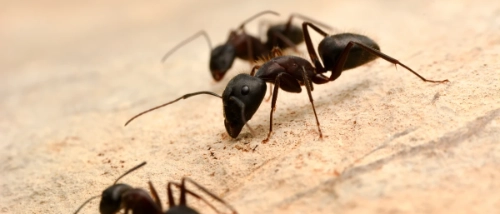
Seasonality
Carpenter ants are active for much of the year, typically from February through November. Their activity increases in spring and summer, when warmer temperatures support foraging and swarming. This is often when people first attempt to identify carpenter ants.
During the colder months, carpenter ants may remain active inside heated homes, particularly in humid areas where moisture is present. Because activity can continue year-round indoors, ongoing vigilance is important for early detection and elimination.

Professional Carpenter Ant Control & Removal
Since carpenter ants often nest in hidden places, hiring a professional is usually the best way to get rid of them. Effective treatment depends on correctly identifying the ants, finding their nests, and understanding how their colonies work. Surface treatments by themselves rarely solve the problem.
Professionals inspect your building to find active trails, moisture sources, and nesting sites. Treatment plans target visible ants , the colonies that sustain them, and contributing conditions like leaks and wood-to-soil contact. Trying to get rid of carpenter ants yourself might help for a while, but DIY treatment often misses the colony. For residential and commercial properties, carpenter ant control often requires an integrated approach through domestic pest solutions or comprehensive facility pest management programs.
Browse Other Pests
Frequently Asked Questions About Carpenter Ants
Carpenter ants usually build their nests in moist or decaying wood, including tree stumps, logs, and wooden structures inside buildings. Satellite nests may also form in wall voids, attics, or crawl spaces.
Carpenter ants are primarily nocturnal and rely on multiple nests rather than a single centralized colony. Unlike many ant species, they excavate wood for shelter rather than consuming it.
Carpenter ants are not venomous and rarely bite unless provoked. Their main risk is structural, as prolonged nesting in wood can weaken buildings over time.