© 2026 Rentokil Initial plc © JP Pest Services. All Rights Reserved.
Accurate pavement ant identification reveals important differences in nesting habits, food preferences, and activity patterns, compared to other species, which is vital for treatment planning. When ants are misidentified, pest control may only focus on visible ants rather than the colony beneath the surface.
Professionals consider several factors to identify pavement ants, including size, color, and movement patterns. However, the location of ant activity is often the most reliable clue. If they emerge from cracks in concrete, expansion joints, or pavement seams, they’re likely to be pavement ants. Without reliable pavement ant control, they may continue appearing for months in or around homes and businesses. With a holistic understanding of pavement ant behavior and characteristics, it’s much easier to create an effective long-term solution.
Species: Tetramorium caespitum
Season: Spring, Summer, Autumn, Winter
Size: 1/8” or less
Region: Throughout U.S.
About Pavement Ants
Pavement ants are widespread near homes and businesses. They are well-adapted to urban living in areas with extensive concrete surfaces, establishing colonies beneath sidewalks, patios, foundations, driveways, and paved areas, where temperature and moisture levels remain relatively stable.
Pavement ants have been known to consume insects, seeds, honeydew, honey, bread, meats, nuts, and cheese. They forage in trails for distances up to 30 ft and can climb masonry walls to reach attics and eaves.
There is a strong link between pavement ants and sanitation; therefore, a persistent infestation can indicate underlying issues with hygiene or property maintenance. JP Pest technicians locate indoor and outdoor nests, targeting treatment to all affected areas.
If you are experiencing a problem with Pavement ants in your home, find out more about our ant control process.
Seeing Ants?
Call now to book your free inspection.
How to Spot Pavement Ant Infestations
Pavement ant infestations are often first identified by swarms of worker ants actively foraging for food scraps indoors. Look out for these possible signs of a colony:
- Consistent ant trails along foundations, concrete seams, and indoor areas near food; these often signal nearby pavement ant nests.
- Fine soil pushed out of pavement cracks or joints can indicate an established nest nearby.
- Recurring indoor ants near kitchens or entryways typically originate from outdoor nests rather than indoor nesting sites.
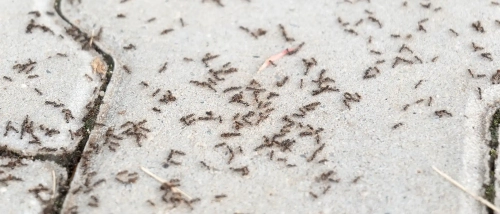
Pavement Ant Life Cycle
Knowing the pavement ant life cycle helps explain why infestations last if nests are not treated. Colonies begin when a queen lays eggs deep within the nest. Eggs develop into larvae, then pupae, and finally adult ants.
As the colony grows, worker ants take over foraging and nest expansion. If treatments fail to interrupt the life cycle, ant populations can expand into the thousands. This is why long-term control depends on targeting the colony, not just visible ants.
Professional treatments aim to disrupt the pavement ant life cycle at the source. This strategy is crucial in preventing repeated infestations that can result from ineffective surface treatments.
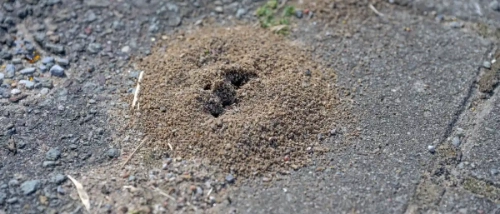
Concrete Ants Nest
One feature that sets pavement ants apart is concrete nests that protect them from the weather, predators, and temperature swings, allowing them to remain active for longer periods.As the colony grows, ants spread through cracks and joints, often pushing fine soil up through pavement seams.
Locating the hidden nest is critical, as surface sprays rarely reach colonies beneath concrete. If nests remain untreated, ants are likely to return. Large properties may contain multiple concrete nests, sometimes connected underground, with each one potentially supporting thousands of worker ants. At JP Pest Services, we work to locate and treat every nest associated with an infestation for maximum protection.
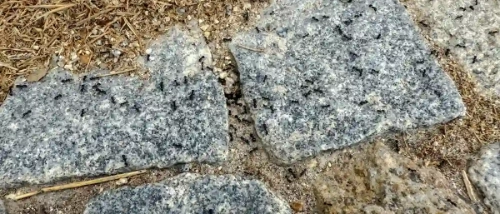
Concrete Ant Habitat
The environment around certain buildings helps support concrete ant nests. Pavement ants prefer areas where concrete meets soil, particularly where cracks allow access below the surface. Moisture from irrigation, rain, or poor drainage further supports nest development.
Concrete also retains heat, allowing nests to remain active even during cooler months. Landscaping debris, shade, and nearby food sources can increase activity. Understanding these conditions helps reduce the likelihood of nests forming.

Pavement Ant Behavior
Studying pavement ant behavior offers intriguing clues to its identity. Like other ant species, they are opportunistic omnivores that search for food in an organized manner, following scent trails from their nest to food sources. However, unique to pavement ants are the ritualized territorial battles (‘ant wars’) that take place between neighboring colonies. These battles involve thousands of workers tugging and pulling, rather than lethal combat, as they fight for resources and expansion sites.
Understanding pavement ant behavior helps professionals trace trails back to the nest. While pavement ants do not damage structures, their persistent foraging can become disruptive.
Seasonality
Seasonal changes affect infestation patterns. Spring and summer bring increased activity, while warm temperatures encourage nest growth and foraging.
In the fall and winter, pavement ants may move indoors in search of warmth; however, these sightings usually lead back to a nest located beneath concrete. Early treatment can help prevent repeat infestations before colony numbers increase.

Contact JP Pest Services for Pavement Ant Control
If ants keep returning even after cleaning and exclusion, it may be time to call a professional. The experts at JP Pest Services can identify the species and find nesting sites. Our tailored residential and commercial pest solutions deliver lasting results, not temporary relief. If pavement ants are active on your property, our team will eliminate the entire colony and secure your building against future infestation.
Browse Other Pests
Frequently Asked Questions About Pavement Ants
Pavement ants are omnivores and feed on a variety of foods, including sweets, proteins, and greasy or fatty substances. They are commonly attracted to crumbs, spilled drinks, and pet food.
Pavement ants are not known to transmit diseases or pose a direct threat to humans or pets, although they can contaminate food and sometimes bite when disturbed.
Pavement ants often nest under sidewalks, driveways, patios, and the foundations of buildings. They create small openings in the concrete and push out fine soil, forming visible mounds near cracks or seams.