© 2026 Rentokil Initial plc © JP Pest Services. All Rights Reserved.
Yellow jackets are social wasps active throughout the U.S. during summer and autumn. They are known for their bold black and yellow coloring and are sometimes mistaken for bees. While they play a small role as pollinators and help control other insects, their aggressive nature and painful stings threaten humans and pets. Yellow jackets build nests in tree cavities, wall voids, attics, or under eaves, creating safety concerns in outdoor work and dining spaces.
Species: Vespula spp. & Dolichovespula spp.
Season: Summer, Autumn
Size: 10-16 mm
Region: Throughout the U.S.
Yellow Jackets Identification
Yellow jackets are aggressive and quick to defend their nests. Swatting at one can be seen as a threat, triggering a painful sting. For people with allergies, a sting may lead to a severe reaction, including anaphylaxis, which requires medical care. Recognizing yellow jackets early and knowing how to spot them can help lower the risk of being stung.
Yellow Jacket
Distinctive connected or detached black spots. Progressively yellow towards the base of its abdomen.
Honey Bee
Fuzzy thorax with yellow and black hoops the full length of its abdomen.
Paper Wasp
Narrow waist with long legs that dangle when flying.

Yellow Jackets Behavior
Yellow jackets' behavior is driven by their aggression and natural desire to protect the nest. Unlike bees, they can sting multiple times without dying, making them more dangerous in group encounters, particularly near nesting areas.
They are highly territorial and fiercely defend their nests, hidden underground, inside walls, or hanging from eaves and trees. When not defending the colony, workers spend much of their time maintaining the nest structure and regulating its internal temperature. This includes fanning their wings to keep the nest cool and expanding nest chambers to support the growing population.
As social wasps, they operate in well-organized colonies with thousands of members. All workers are female, performing roles like foraging, feeding the queen's offspring, and defending the nest. Males appear late in the season, serving only to mate before dying off in colder weather.
Yellow Jackets Life Cycle
Understanding the yellow jackets' life cycle can help predict when infestations are most likely to occur. Colonies begin in early spring when a fertilized queen emerges from hibernation. She finds a suitable nesting site, starts laying eggs, and raises the first batch of workers.
These workers take over nest duties while the queen focuses solely on reproduction. Over the summer, the colony can grow to include over 1,000 individuals. During this time, foraging and defensive activity peak. By late summer, usually around August, male yellow jackets begin to appear. They do not work in the colony but serve as mates for new queens.
As temperatures drop in autumn, the males die off and fertilized queens leave the nest to find shelter for the winter. The rest of the colony, including the old queen, perishes with the first hard frost, while new queens start the cycle again the following spring.
Yellow jacket colonies do not reuse nests from the previous year. Each season starts fresh, though nesting sites are often in the same general locations.
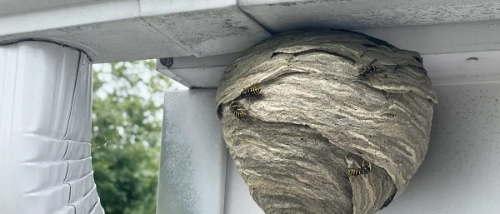
Yellow Jackets Habitat & Nesting Habits
Their nests are made from chewed wood mixed with saliva, creating a papery structure. Depending on the species and environment, a yellow jacket nest can be above or below ground.
Typical nesting sites include:
- Underground burrows
- Wall cavities in homes, warehouses, and distribution centers
- Roof eaves in homes and commercial buildings
- Tree branches or shrubs
- Decks and sheds in backyards and outdoor cafeterias
They choose areas that are sheltered and near food and water sources. This brings them close to human activity, increasing the risk of stings. Ground nests are often accidentally stepped on, while aerial nests might go unnoticed until disturbed.
Trying to remove a nest without proper equipment can be dangerous. Our wasp pest control professionals can assess and handle troublesome infestations so you don’t have to.
Diet and Feeding Patterns of Yellow Jackets
Yellow jackets are both pollinators and scavengers. Their diet includes live insects, meat, and sweet liquids. They feed protein to larvae and consume carbohydrates for energy. This explains why they are often found around trash bins, picnic areas, and compost piles. Sugary drinks, fruits, and leftover food attract adult workers. Meat scraps or pet food can also be a draw.
Their feeding activity intensifies in late summer as the colony population peaks and natural food sources begin to dwindle. This makes them more aggressive and persistent in seeking human-provided food sources.
Foraging yellow jackets may hover around open cans and food wrappers or even enter vehicles for leftovers. These behaviors make them a nuisance in both domestic and commercial pest control settings.
Avoid leaving food uncovered outdoors and use tight-sealing trash bins to reduce the chance of attracting yellow jackets. While traps may help reduce activity, they do not address the root cause: the nest.
Frequently Asked Questions
Yellow Jackets (Vespula) are short, stocky wasps with distinct black-and-yellow bands. They are far more aggressive than bees or paper wasps and can sting multiple times without losing their stinger. As they use a "marking pheromone" to signal their colony to attack, a single disturbed nest in a New England yard can lead to dozens of stings in seconds.
From April through the first hard frost in November. The "danger window" peaks in late September when colony populations reach their maximum size (up to 5,000 workers), and natural food sources decline, making them highly territorial and prone to unprovoked attacks.
They are "cavity nesters". So while some species build underground in abandoned rodent burrows, the most dangerous infestations we treat are in residential wall voids and attic eaves. If you see yellow jackets entering a hole in your siding, NEVER plug the hole. This will force the colony to chew through your drywall to find a new exit, often leading them directly into your bedroom or kitchen.
Only the fertilized queens survive by overwintering in protected spots like woodpiles or behind loose house siding. If you see a large, solitary yellow jacket inside your home during a warm spell in February, it’s likely a hibernating queen that’s been "tricked" by your home’s heating system into waking up early.
Warning: Do Not Block the Entry Hole
If you have a nest in your wall void, a DIY mistake drilling through your wall could send the colony into your living room. Identifying the nest type and location is the first step to a safe removal. Request a Wasp or Yellow Jacket Removal Quote.