© 2026 Rentokil Initial plc © JP Pest Services. All Rights Reserved.
The Common House Fly, Musca domestica, may seem commonplace, but understanding its appearance, life stages, and behaviors reveals its resilience in human environments. These fast-breeding insects thrive wherever humans live and work. They're more than irritating; they can spread disease and indicate sanitation problems.
To address persistent house fly invasions, our team stands ready to assist with inspection, treatment, and prevention measures tailored to your needs. Wherever you are in New England, from Maine to Massachusetts, Rhode Island, or Vermont - we’ve got your back against pesky house flies. Give us a call today for a free consultation.
Species: Musca Domestica L.
Season: Spring, Summer, Autumn, Winter
Size: 1/4″
Region: Throughout the U.S.
House Fly Control Services in New England
House fly control services help eliminate house flies by addressing the conditions that allow these fast-breeding insects to thrive in homes and businesses across New England.
Our professional service begins with an inspection to identify attractants and entry points, followed by targeted treatments and recommendations designed to reduce breeding areas and limit future activity.
At JP Pest Services, we tailor fly control plans to each property, whether it is a home, restaurant, retail space, or food-handling facility. Our approach focuses on managing active fly issues and the factors that support them, helping properties maintain better control throughout the year.
Struggling with Flies?
Call now to book your free inspection.
Common Household Fly Facts & Identification
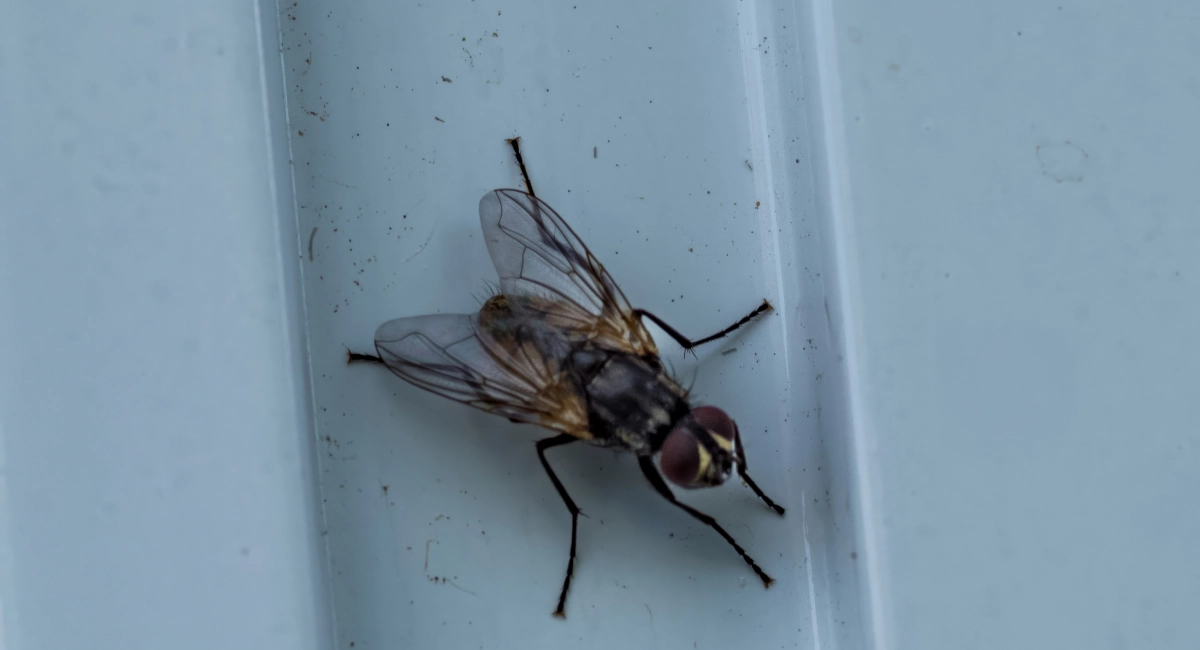
The common household fly reaches about 6 to 7 millimeters in length and is immediately recognizable. Its thorax is dark gray, with four prominent longitudinal stripes running down its back. The eyes are large, compound, and red, providing excellent vision. Beneath the wings, the abdomen may appear slightly lighter, sometimes with pale patches toward the far end. Wings are clear with soft smoky lines. They lie flat when at rest. Halteres, the small balancing organs, are seen behind the wings.
These insects are often called common house flies or filth flies, as they breed and feed on decaying organic waste. Their fast and unpredictable flight, along with their love for human food, trash, and animal waste, helps them thrive near people. Spotting a fluttering cloud in the kitchen, backyard, or near a compost bin is often your first clue to a possible common house fly infestation.
Female flies have rounder abdomens than males. They usually lay multiple batches of eggs during their short lives. Common house fly larvae, small white maggots found in garbage or decaying material, confirm that active reproduction is happening nearby.
What Do Common House Flies Look Like?
The adult common house fly has a segmented body with six legs ending in sticky pads and minute claws that allow it to walk on any surface, even ceilings. These flies have mouths that are adapted for sponging up liquids, and allows for solid food to dissolve easily. Though evidence of chewing is absent, saliva breaks down solids for eating.
Larvae, known as maggots, emerge from eggs in about 24 hours. They are legless and white and grow to around 8 to 12 millimetres. When they are fully grown, the larvae dig into dry materials like soil or straw. They create a puparium, which is a hard brown shell. This is where metamorphosis happens. Once the common house fly life cycle completes, adults emerge within a few days.
Each stage; egg, larva, pupa, adult; fine-tunes the fly's ability to exploit human environments for breeding and survival. This makes them highly successful and a high priority for management.
Understanding Common House Flies
To fully understand the Common House Fly, you need to know its seasonal patterns and habits. You should also see how its life cycle adapts to human-influenced environments. This awareness supports informed control efforts.
Common House Fly Behaviors, Diet, Habitat & Life Cycle
Adults typically live 15 to 30 days and may survive longer in favorable conditions. Females can lay up to 300 eggs in a single batch, with several batches over their lifespan.
Eggs are laid on wet, rotting organic matter. This includes garbage, decaying fruit, feces, manure, or compost. These spots offer shelter, warmth, and food.
Larvae emerge within 24 hours. During the larval stage, feeding is constant until they drop into drier areas to pupate. In optimal temperatures (25–30 °C), the transition from egg to adult can take 7–10 days. Under cooler or drier conditions, development slows or enters dormancy.
Adults spend much time resting on vertical surfaces between feedings. Human foods like fruit, meat, sauces, drinks, and pet food are often targeted. They offer carbs, salts, and proteins that are key for egg production. Their diet includes sap, spilled drinks, and even wall moisture. Unlike actual predators, they don't hunt but depend on available substances.

Common House Fly Signs, Lifecycle, Behaviors, and Habits – Seasonality and its Phases
In temperate regions, the life cycle accelerates from spring through summer, resulting in booming populations. Spring brings the first adult flies from overwintering pupae. Each generation breeds faster as temperatures rise, leading to noticeable swarms in June, July, and August.
Autumn slows activity, but egg-laying may continue if food is available. In winter, development pauses in cool environments until warmth returns. Flies can complete multiple generation cycles during warmer months, leading to quickly spiraling infestations.
Behaviorally, adults are day-active, drawn to lights in early mornings and late evenings. They avoid heat and direct midday sun by seeking shaded areas. Outdoors, they remain near garbage bins, sheds, barns or livestock shelters. Their flight is not strong across windy distances; many concentrate close to their breeding grounds.
Get Rid of Common House Flies
To manage common house flies, you need to remove their breeding sources to prevent new generations. A layered approach combining sanitation, exclusion, and removal methods is most effective.
Hygiene
Begin by removing food sources that attract flies. Keep all human foods stored in sealed containers. Clean countertops and floors to remove spills or crumbs. Do not leave food uncovered. Remove organic material that could support larval growth. Pet droppings, livestock waste, clogged gutters, fallen produce, and yard debris are prime breeding materials.
Repair
Sealing entry points is essential. Fit or repair tight screens for windows and doors. Caulk cracks and gaps in siding, plumbing, and utility entry points and around vents or soffits. The sticky pads on fly legs allow them to enter through small openings, so hinges less than two millimeters can be used. Filtering the perimeter of your property with good sealing is an essential barrier.
Pest Control Tools
UV light traps inside food prep areas or trash collection points can catch adult flies before spreading eggs. Sticky ribbons or fly strips are also useful in low-traffic corners. However, their chemical-free design is optimal for sensitive areas like kitchens and cafeterias. For outdoor trash zones, placing mechanical fly traps away from doors helps reduce nearby fly populations.
If flies keep coming back, it’s time for professional help. Trained technicians can spot hidden breeding sites for flies. They can also apply targeted treatments in difficult-to-reach areas and offer long-term monitoring. These systematic efforts help disrupt fly patterns and limit reproduction cycles.
Whether carried out by homeowners or professionals, effective fly control depends on integrating multiple strategies into an ongoing plan, such as sanitation, exclusion, monitoring, and elimination.
Frequently Asked Questions
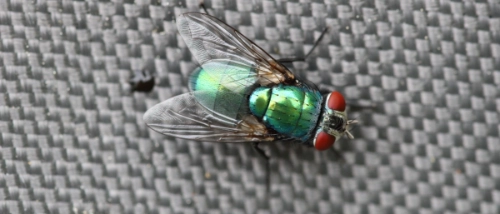
Common house flies (Musca domestica) are dull gray, measuring about ¼ of an inch. They’re easy to identify in New England kitchens as they have four dark stripes down their body and large, reddish compound eyes. Unlike shiny metallic "bottle" sheen blow flies, house flies have a matte finish, so they’re harder to spot against dark surfaces.
Their adult lifespan is typically 15 to 30 days. But in the climate-controlled environments of modern Massachusetts and New Hampshire homes, they can be active for longer. A single female lays up to 900 eggs in her lifetime, so one fly today can become a swarm within two weeks if breeding sites aren't eliminated.
House flies can only ingest liquids. So their "sponging" mouthparts regurgitate saliva onto solid food—including human meals and garbage—turning it into liquid. This feeding mechanism is why they are the main carrier of more than 65 diseases, including Salmonella and E. coli, which we frequently monitor in commercial food service accounts.
They thrive in fermenting or decaying organic material. While "rubbish" is a broad term, our technicians often find localized breeding in uncleaned floor drains, the bottom of trash valets, and damp compost piles near residents’ doors and windows. In rural New England, livestock or manure close by is a major contributing factor to high fly pressure.
Under ideal summer temperatures (around 80°F), from egg to adult takes only 7 to 10 days. As they breed so rapidly, "DIY" fly sprays only kill the adults. But to stop an infestation, you must break the cycle by removing the moisture-rich breeding material within the first week of seeing activity.
Stop the Cycle: Start with the JP Audit
Don't just swat them: find out where they are coming from with a JP fly audit. Most house fly issues in New England start in three specific "hidden" zones: attics and wall void; sink drains; and outdoors near garbage cans or compost piles. Find out more about Fly Control Service or contact us for a free quote.